
Porcelain slabs and sintered stone
The terms porcelain slabs, sintered stone, sintered surfaces and ultra-compact surfaces are often used interchangeably in the architectural surface industry. While there is significant overlap between these products, the terms do not necessarily describe exactly the same material or manufacturing process.
What does “sintered” mean?
Sintering is a manufacturing process, not a specific type of material.
In simple terms, sintering involves compacting mineral or ceramic particles and subjecting them to high temperatures so that the particles bond and consolidate into a dense, durable material.
Porcelain is manufactured using this principle. Fine mineral and ceramic raw materials are compacted and fired at high temperatures, resulting in the dense, low-porosity material characteristic of porcelain.
The term “sintered stone”, however, has also developed as a commercial term for a range of highly compacted mineral surfaces manufactured using sintering and related technologies. These products may use formulations and manufacturing processes that differ from conventional porcelain.
As a result, porcelain and sintered stone should not necessarily be treated as two completely separate material categories. Some products marketed as sintered surfaces may have characteristics closely associated with porcelain, while others are developed as distinct ultra-compact mineral surfaces.
Porcelain slabs
Porcelain slabs are large-format ceramic surfaces manufactured from carefully selected clays, feldspars, silica and other mineral raw materials. The materials are compacted and fired at high temperatures to produce a dense, hard and low-porosity surface.
Porcelain is defined by its technical characteristics rather than simply by its size or appearance. In the tile industry, porcelain products are generally characterised by very low water absorption, commonly ≤0.5%.
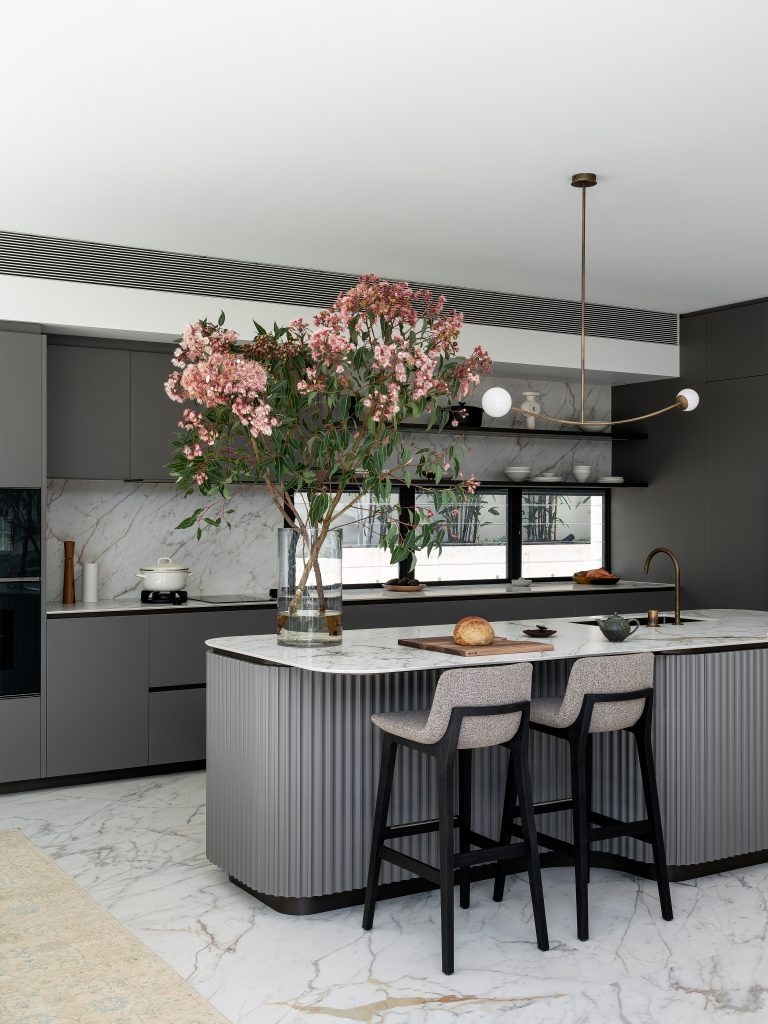
Large-format porcelain slabs can provide the appearance of natural stone, concrete, marble and other materials while offering the durability and low maintenance associated with porcelain.
Typical characteristics include:
- Very low water absorption
- High resistance to staining
- High resistance to scratching and abrasion
- Resistance to UV exposure
- Resistance to many household chemicals
- High resistance to heat
- Easy cleaning and maintenance
- No routine sealing required
- A wide range of colours, patterns, textures and finishes
- Suitable for a wide range of interior and exterior applications when the product is correctly specified
Porcelain slabs are available in a range of thicknesses and formats, depending on the manufacturer and intended application. They can be used for flooring, walls, splashbacks, furniture, benchtops, outdoor areas and façades, subject to the relevant product specifications and installation requirements.
Sintered stone and ultra-compact surfaces
Sintered stone is a term used within the architectural surface industry for highly compacted mineral surfaces manufactured using sintering technology.
These products typically use carefully selected natural mineral raw materials that are compacted under high pressure and then consolidated at high temperatures. Some manufacturers use proprietary technologies that combine ultracompaction with particle sintering to achieve particularly dense and durable surfaces.
The exact composition and manufacturing process varies between products, so “sintered stone” should not be treated as a single standardised material with one universal formulation or set of properties.
Depending on the product, sintered surfaces can offer:
- Very low water absorption
- High resistance to staining
- High scratch and abrasion resistance
- High UV resistance
- Resistance to heat and many household chemicals
- Low-maintenance surfaces that generally do not require sealing
- Large slab formats and multiple thickness options
- A wide range of natural stone, concrete and architectural finishes
- Interior and exterior applications, subject to the manufacturer’s technical specifications
Some manufacturers use terms such as ultra-compact surface, sintered surface or sintered stone to distinguish their products from conventional porcelain, particularly where proprietary formulations, higher compaction or specialised manufacturing technologies are used.
So, what is the difference?
The simplest way to understand the terminology is:
Sintering is a manufacturing process. Porcelain is a type of ceramic material. Sintered stone is a commercial term used for certain highly compacted mineral surfaces manufactured using sintering technology.
There is therefore significant overlap between porcelain and sintered surfaces, and the terminology used by manufacturers can vary.
Rather than relying solely on the product name, the most important considerations when specifying a slab are its technical characteristics, intended application, thickness, dimensions, water absorption, strength, slip resistance, chemical resistance, thermal performance, UV resistance and installation requirements.
Choosing the right surface
Both porcelain slabs and sintered surfaces can provide excellent performance when correctly specified and installed.
For each application, always refer to the manufacturer’s current technical documentation to confirm that the particular product is suitable for its intended use.
For flooring and other areas where slip resistance is relevant, the product should be assessed against the applicable Australian requirements and the manufacturer’s documented test results. Slip resistance should not be assumed from the material category alone, as the finish and surface texture have a significant influence on performance.
Likewise, suitability for benchtops, façades, external paving, pool surrounds and other specialised applications should be confirmed using the manufacturer’s technical documentation and installation requirements.
In short, “sintered” describes how a material is produced, while “porcelain” and “sintered stone” describe materials/products that can overlap considerably in composition, manufacturing technology and performance.
DISCLAIMER All material on this website is published in good faith, however Skheme Pty Ltd does not warrant or represent the origin, validity, accuracy, completeness, timeliness, authenticity or reliability of, nor accept any responsibility for errors or omissions, in any material on this website or in any accompanying or other material, including advertisements, whether oral, visual, written, printed or electronic. Skheme Pty Ltd is not liable for any losses, claims, damages, demands, costs and expenses of whatsoever nature arising in any way, including those caused by negligence, out of or in connection with the use of this website, or any accompanying or subsequent information, or by reason of any reliance upon its contents by any person, company or organisation. All access to, and use of, the information is at the user’s risk. All technical details, recommendations and other information contained on this website represent the best of our knowledge and experience at the time of publishment. It is your responsibility to ensure that our products are used and handled correctly and in accordance with any applicable Australian Standard, our instructions and recommendations and only for the uses they are intended. Country specific recommendations, depending on local standards, codes of practice, building regulations or industry guidelines, may affect specific installation recommendations. The supply of our products & services is also subject to certain terms, warranties and exclusions, which may have already been disclosed to you in prior dealings or are otherwise available to you on request. Skheme reserves the right to alter, amend, vary or otherwise change any information on this website at any time and without prior notice to you to reflect our ongoing research and development program. The provision of any URL or link is done for the convenience of users of this website. It does not constitute an endorsement by the Skheme of that URL or link or the information at that Internet site. Potential customers should speak to a Skheme consultant regarding the qualities, colours and textures of all Skheme products before purchase.